Email has accompanied us since the dawn of the Internet, and neither the boom of instant messaging nor the success of social media has managed to diminish its use. This is particularly noteworthy in the business realm. Did you know that 62.86% of businesses and companies choose to communicate always by email? The reason is simple: emails are not only excellent transmitters of a brand but also offer a professional image and are an exceptional channel to leave a mark on potential clients.
It is estimated that by 2025, more than 376 billion emails will be sent daily. It is not surprising that email marketing is the most effective and profitable channel in the digital landscape. Indeed, for every $1 invested, an email marketing campaign can generate up to $45. Thus, it becomes one of the most effective strategies in digital marketing, offering the highest ROI.
Do you think email is outdated? In today’s article, we will review the main data, trends, and statistics of email marketing to change your mind.
Main Email Marketing Statistics (2025)
- As of today, there are a total of 4.59 billion email users worldwide. (Statista)
- It is estimated that in 2027, 408.2 billion emails will be sent each day. (Statista)
- 81% of companies use email as a foundation for their marketing campaigns. (Forbes)
- 60% of users want to receive emails from their favorite brands. (Square Up)
- 75% of B2B companies use email newsletters as part of their marketing campaigns. (CMI)
- 80% of SMEs claim that email marketing is the most effective way to retain their customers. (SAP Emarsys)
- AI-driven hyper-personalization is the future of email marketing. (Ascend2)
Email Marketing Usage and Reach Statistics (2025)
The use of email, far from being sidelined by the rise of instant messaging and social media, is strengthening year after year. The following data shows why it is a channel to consider for any business or information professional.
The number of email users has reached 4.6 billion globally
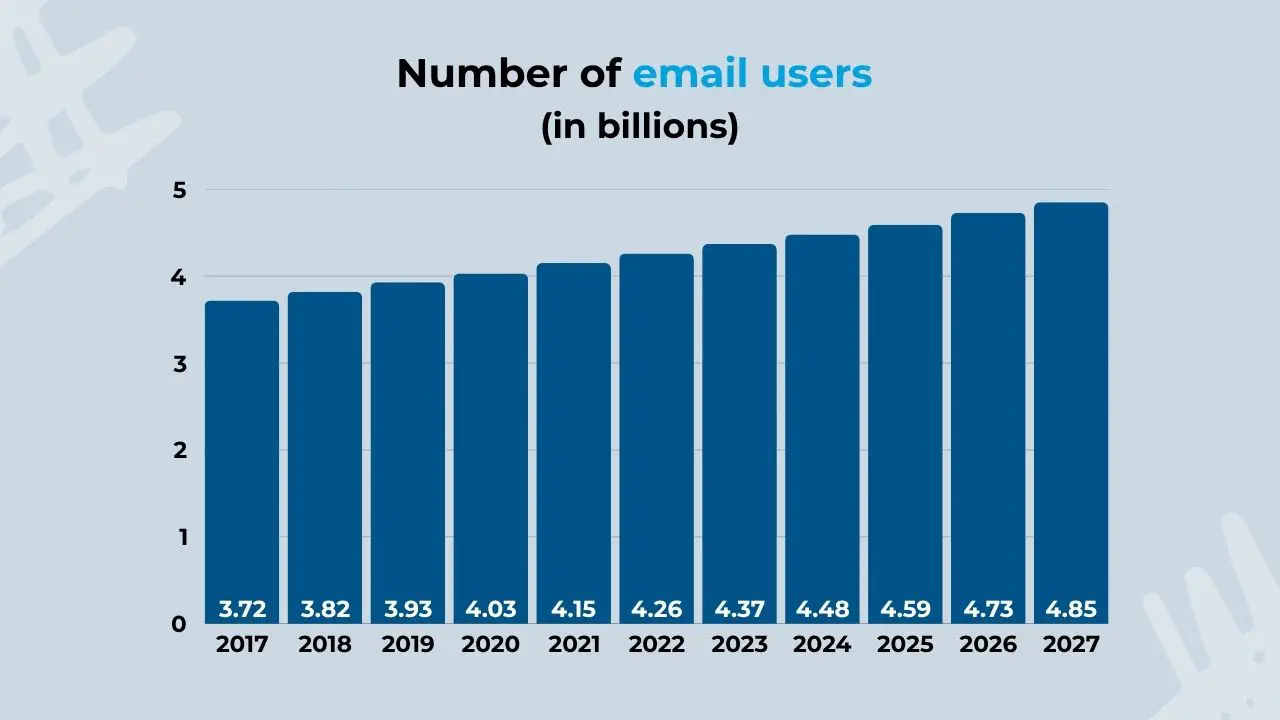
Despite the rise of messaging services and social media, email use continues to grow exponentially year after year. This is indicated by a recent study conducted by Statista, which estimates that this year a total of 4.59 billion email users will be reached, and the number will rise to 4.85 billion by 2027.
| Year | Number of users (globally) |
|---|---|
| 2017 | 3.72 billion |
| 2018 | 3.82 billion |
| 2019 | 3.93 billion |
| 2020 | 4.03 billion |
| 2021 | 4.15 billion |
| 2022 | 4.26 billion |
| 2023 | 4.37 billion |
| 2024 | 4.48 billion |
| 2025 | 4.59 billion |
| 2026 | 4.73 billion |
| 2027 | 4.85 billion |
It is estimated that by 2027, 408.2 billion emails will be sent daily
As of today, a total of 376.4 billion emails are sent daily, and according to Statista, this trend is expected to continue rising. A recent study suggests that by 2027, 408.2 billion emails will be sent daily, representing a nearly 30 billion increase in just two years.
| Year | Daily number of emails (global) |
|---|---|
| 2018 | 281.1 billion |
| 2019 | 293.6 billion |
| 2020 | 306.4 billion |
| 2021 | 319.6 billion |
| 2022 | 333.2 billion |
| 2023 | 347.3 billion |
| 2024 | 361.6 billion |
| 2025 | 376.4 billion |
| 2026 | 392.5 billion |
| 2027 | 408.2 billion |
88% of email users check their email several times a day
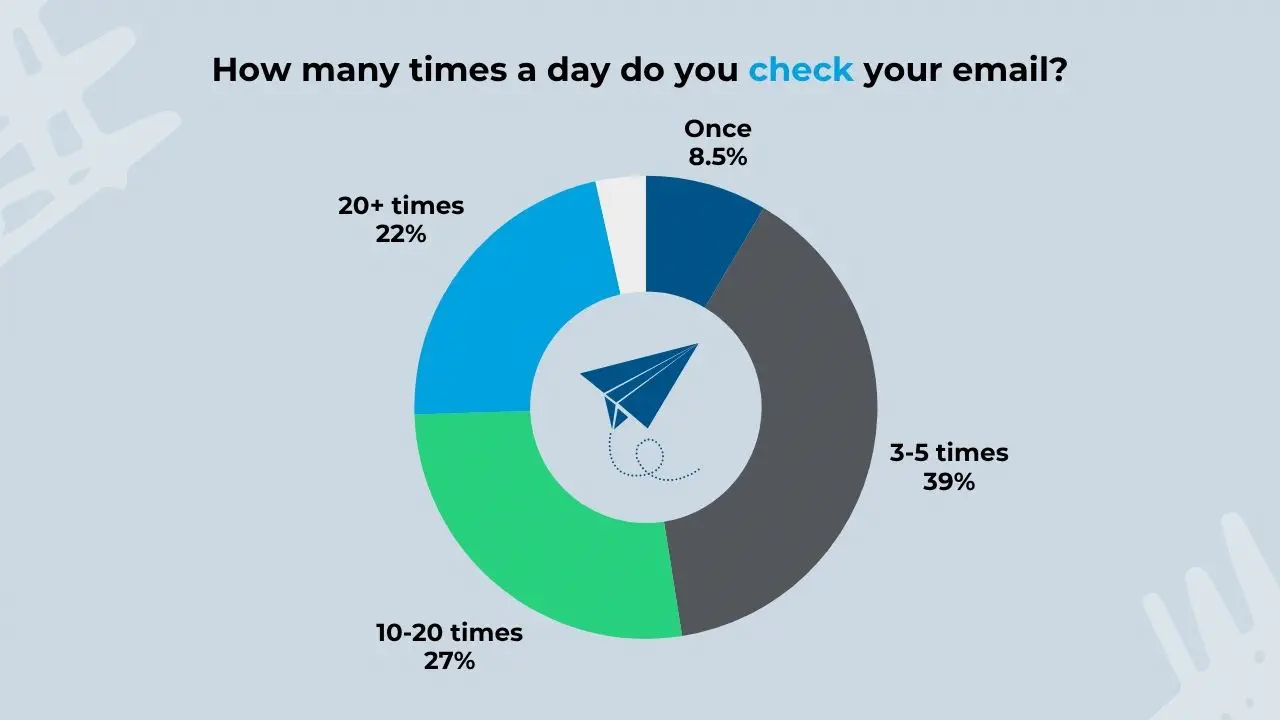
Email marketing campaigns are highly effective, largely due to the frequency with which users check their inboxes. According to a recent report created by Zerobounce, 88% of email users are always alert to see if they receive any emails.
Below, we detail how frequently these users check their inbox:
Q: How many times a day do you check your email?
- 1 time a day: 8.5%
- 3-5 times a day: 39%
- 10-20 times a day: 27%
- 20+ times a day: 22%
- I do not check my email daily: 3.5%
60% of users want to receive emails from their favorite brands
The use of email is not only intended for communicating with family and friends. In fact, one of its main functions is to connect with brands and companies. A recent study conducted by Forbes reveals that 86% of users want to learn more about their favorite brands, with email being the preferred contact method among 60% of respondents.
81% of businesses use email as the foundation for their marketing campaigns
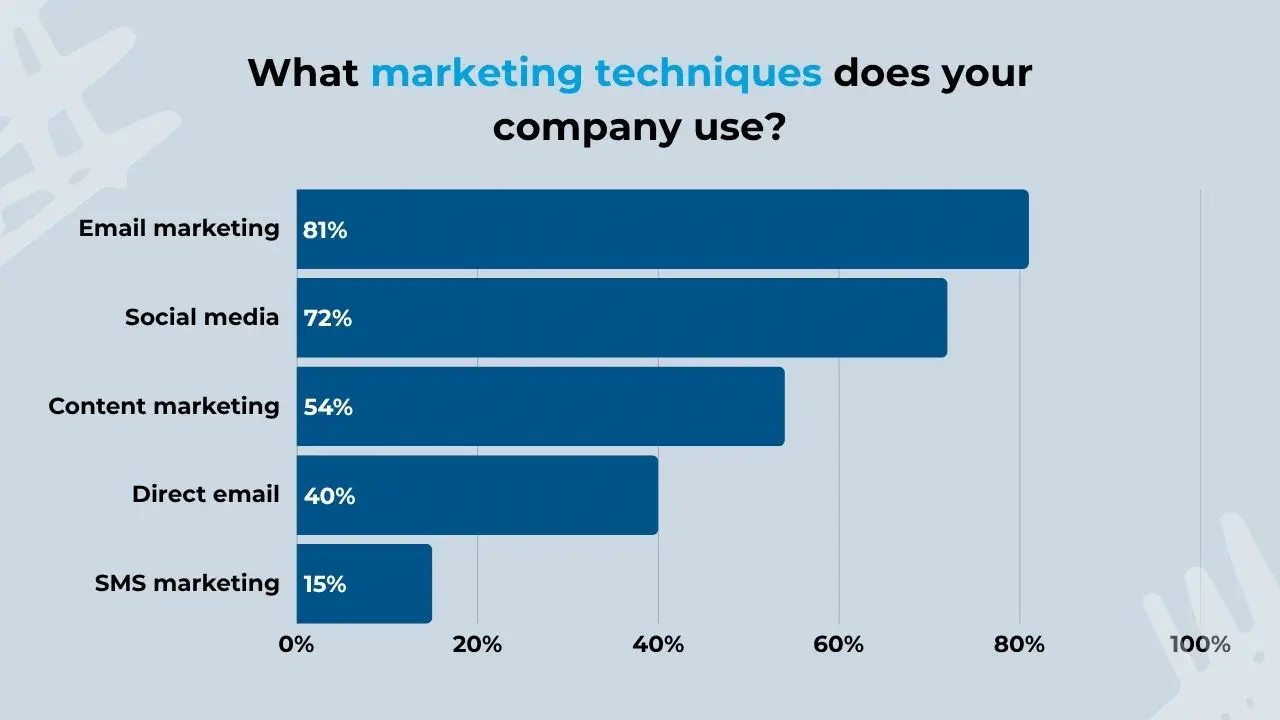
Email marketing is not just another tool for many businesses, but the foundation of their entire digital strategy. As noted by Forbes, 81% of businesses use email marketing as the basis of their entire campaign. These same data are supported by a study conducted by MarketingSherpa.
Q: What marketing techniques does your company use?
- Email marketing: 81%
- Social media: 72%
- Content marketing: 54%
- Direct mail: 40%
- SMS marketing: 15%
Email Marketing ROI (Return on Investment) Statistics
As we have already mentioned, email is not only the most widely used channel but also the most effective and profitable for bringing a marketing campaign to life. Below, we present the most relevant statistics regarding return on investment generated by email marketing.
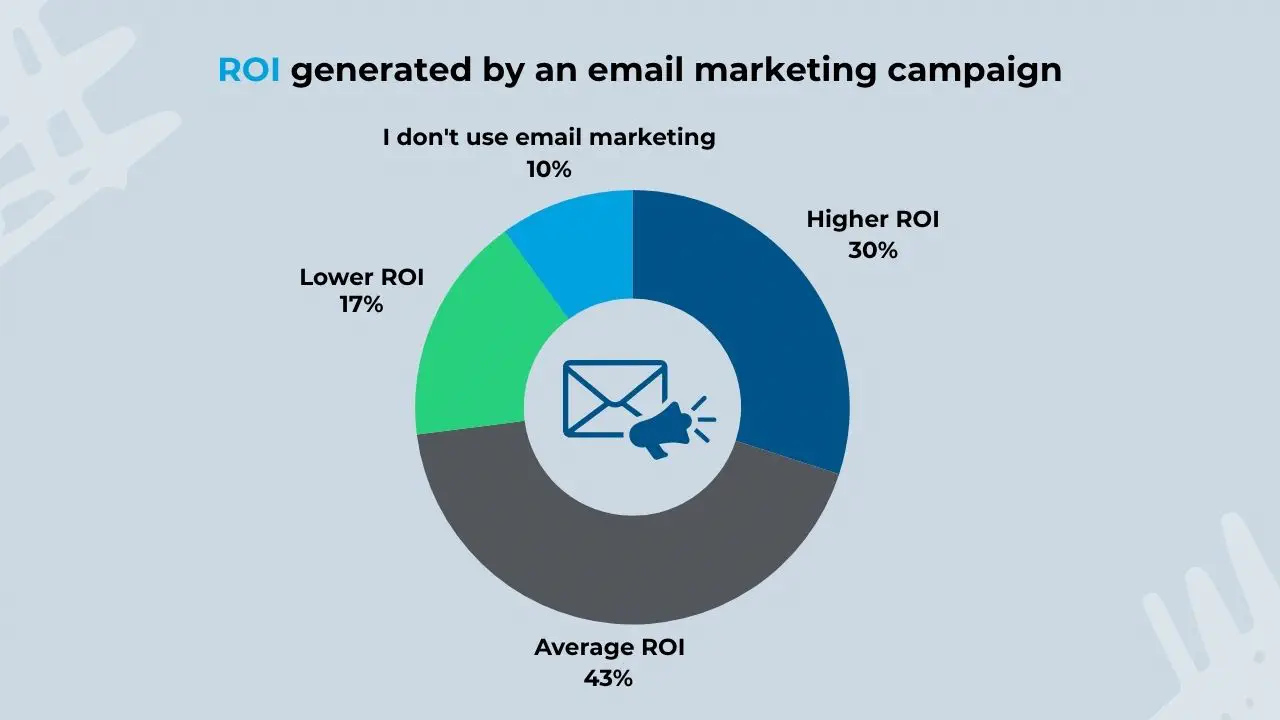
30% of professionals say that email marketing has a higher ROI value
We now detail the survey results regarding how much ROI an email marketing campaign generates.
- Highest ROI: 30%
- Average ROI: 43%
- Lowest ROI: 17%
- I do not use email marketing: 10%
The average ROI of an email marketing campaign is 3600%
The positive results from using email in marketing campaigns can be verified due to the significant gains relative to their initial investment. A study conducted by Litmus shows us how for every $1 invested, an email marketing professional can generate $36. This represents an average ROI per campaign of 3600%.
The e-commerce sector benefits the most from email marketing
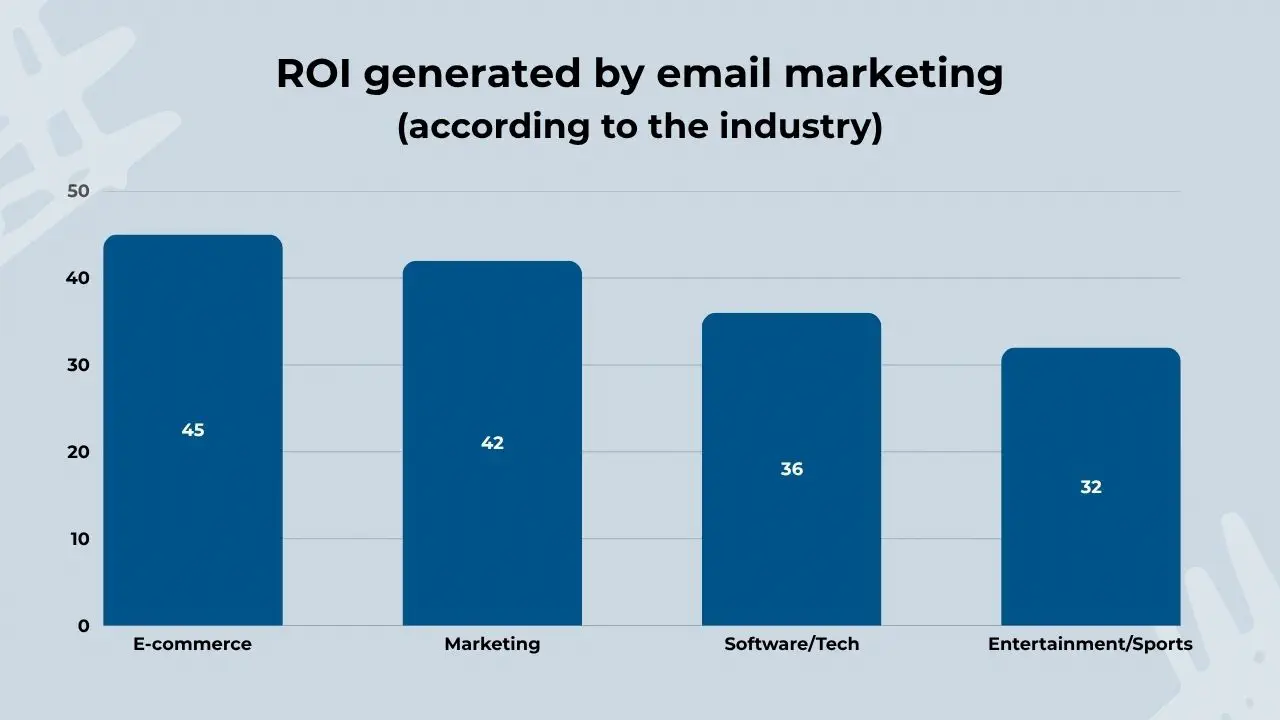
Not all industries that utilize email marketing generate the same ROI. The e-commerce sector, along with retail, yields the highest benefits ($45 for every $1 invested), followed by marketing and advertising agencies ($42 for every $1 invested) and software ($36 for every $1 invested).
We now detail the ROI results generated concerning the sector to which a business belongs:
- E-commerce/Retail: 45:1
- Marketing/Advertising: 42:1
- Software/Technology: 36:1
- Entertainment/Media/Sports: 32:1
Email automation generates 16 times more benefits than manual campaigns
According to Klaviyo, automating emails generates an RPR (Revenue per Recipient) 16 times higher than traditional email campaigns. These are not only much easier to maintain, but by automating, they provide a personalized experience for each customer. This translates into a higher number of sales.
This data comes alongside the report from EmailMonday, which indicates that using dynamic content to create personalized emails can elevate a company’s average ROI by 3100%.
Email Marketing Engagement Statistics (2025)
User interaction with an email is the factor that differentiates a successful email marketing campaign from a disastrous failure. Below, we share what we consider to be the key engagement statistics and trends within email marketing.
The average open rate in email marketing is 37.23%
According to Constant Contact, the average open rate for marketing emails is 37.27%, with a click rate of 1.36% and a bounce rate of 10.68%.
The numbers change depending on the type of business we are engaged in, with the highest open rate in childcare or nursery services (47.77%), social services (42.10%), independent artists (41.92%), and religious organizations (41.76%).
Hubspot provides us with similar data, as well as a detailed list of the average email open rate by industry. It is as follows:
- Retail/Ecommerce: 38.58% (Klaviyo)
- B2B Services (Business-to-Business): 39.48% (Klaviyo)
- Nonprofit Organizations: 46.49% (Brevo)
- Technology/SaaS: 38.14% (Active Campaign)
- Tourism and Hospitality: 45.21% (MailerLite)
The average click-through rate (CTR) in email marketing is 2.66%
The click-through rate measures the number of people who have clicked on one or more links in an email marketing campaign relative to the number of emails sent. The more clicks your email receives, the more likely it is to generate a conversion, such as a sale. In other words, a higher number can translate to a successful campaign.
According to Mailchimp, the average click-through rate is 2.66% for all users, regardless of their industry or sector.
The average click-to-open rate (CTOR) in email marketing is 5.63%
The click-through rate (CTR) is as important as the click-to-open rate (CTOR). While the former analyzes the number of clicks on links in an email against the total number of emails sent, the click-to-open rate measures the percentage of clicks relative to the number of emails opened.
According to a recent report from Growth-Onomics, the average CTOR in 2025 is 5.63%.
Rising Trends in Email Marketing (2025)
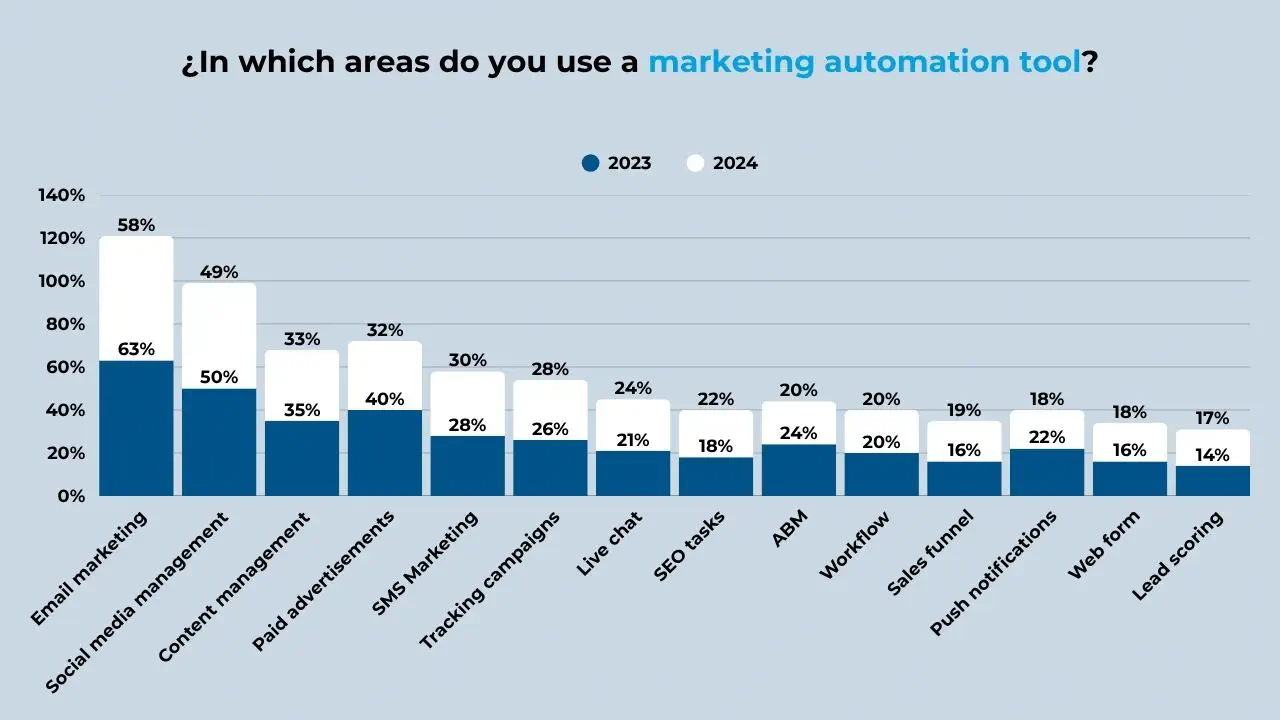
58% of automations are used in email marketing campaigns
Next, we present the results of the study:
Q: Which of the following areas do you use any marketing automation tool?
| 2023 | 2024 |
|---|---|
| Email marketing | 63% |
| Social media management | 50% |
| Content management | 35% |
| Paid ads | 40% |
| SMS Marketing | 28% |
| Campaign tracking | 26% |
| Live chat | 21% |
| SEO tasks | 18% |
| ABM | 24% |
| Workflow | 20% |
| Sales funnel | 16% |
| Push notifications | 22% |
| Dynamic web forms | 16% |
| Lead scoring | 14% |
(Source: Ascend2)
Segmented sends generate 30% more opens and 50% more clicks than unsegmented ones
Segmentation is an email marketing strategy that divides a company’s contact list into smaller groups based on common characteristics among them. This enables the sending of personalized emails tailored to each segment, thereby increasing the likelihood of clicks and conversions.
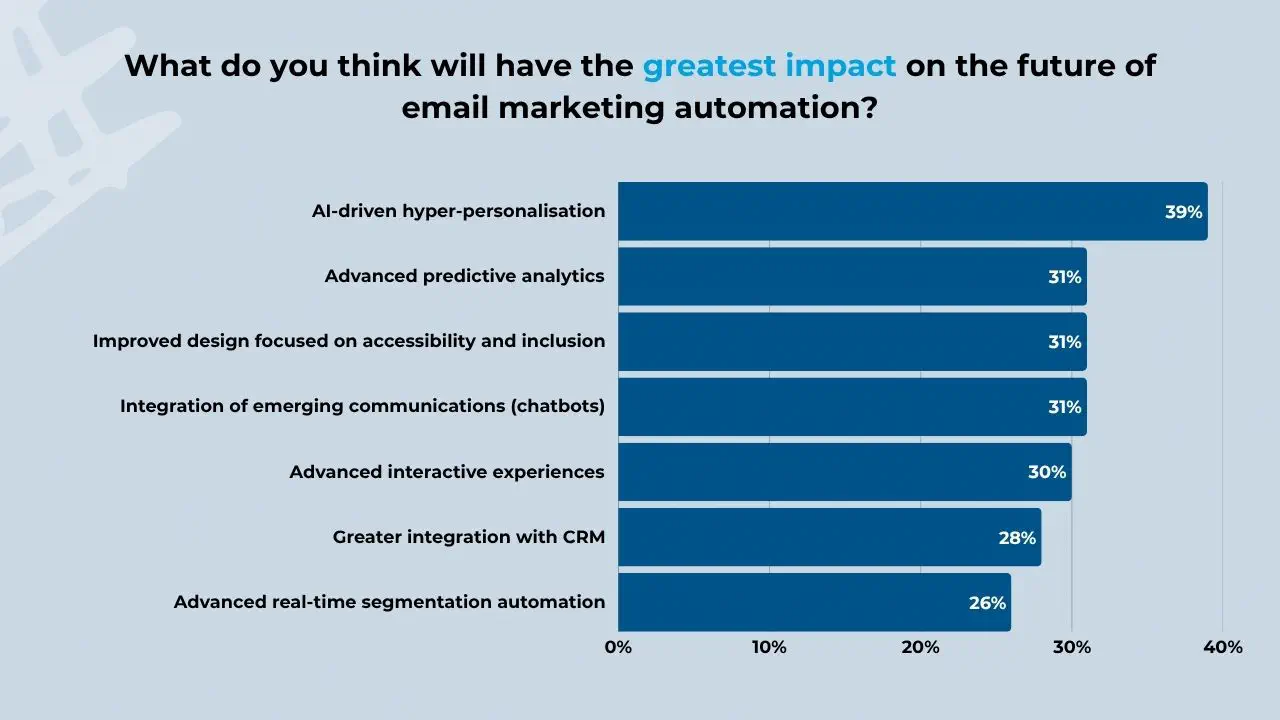
39% of professionals believe that AI-driven hyper-personalization is the future of email marketing
Data does not lie, and personalization always leads to a higher rate of both opens and clicks per email. Thanks to generative AI, it is possible to give an extra twist to the way these emails are personalized, turning them into campaigns tailored to each user.
As shown in the Ascend2 study, The State of Email Automation, 40% of marketers worldwide claim that AI-driven hyper-personalization is the most impactful change in the future of email campaigns.
Q: What do you think will have the greatest impact on the future of email marketing automation?
- AI-driven hyper-personalization: 39%
- Advanced predictive analytics: 31%
- Improved design focused on accessibility and inclusion: 31%
- Integration of emerging communications (chatbots): 31%
- Advanced interactive experiences: 30%
- Greater CRM integration: 28%
- Real-time advanced segmentation automation: 26%
Email Marketing Benchmarks (2025)
To conclude the article, we provide a summary table that outlines the main metrics and benchmarks defining the evolution, trends, and performance of email marketing in 2025.
Average Email Marketing Benchmarks (2025)
| Metric | Benchmark |
|---|---|
| Number of email users | 4.59 billion (global level) |
| Emails sent daily | 376.4 billion |
| Average ROI | 36:1 |
| Average open rate | 37.23% |
| Average CTR | 2.66% |
| Average CTOR | 5.63% |
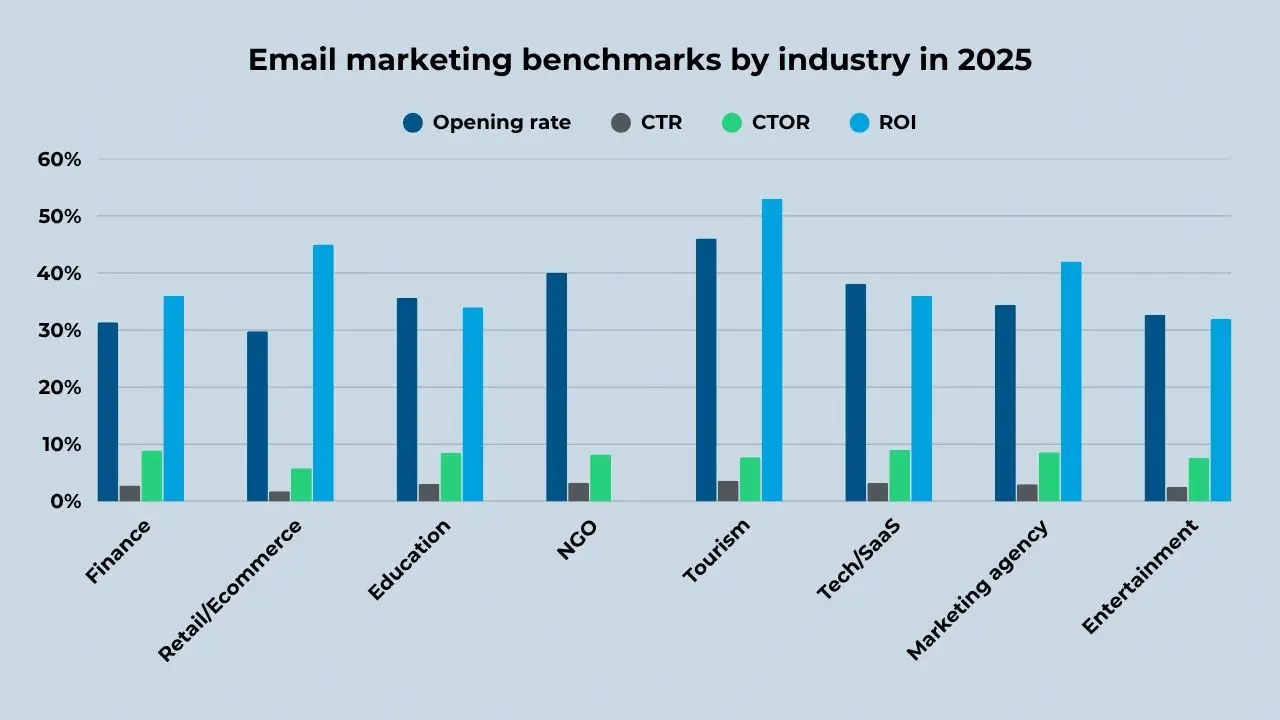
Email Marketing Benchmarks by Industry (2025)
| Industry | Open Rate | CTR | CTOR | ROI |
|---|---|---|---|---|
| Finance / B2B Services | 31.35% | 2.78% | 8.9% | 36:1 |
| Retail/Ecommerce | 29.81% | 1.74% | 5.8% | 45:1 |
| Education/Training | 35.64% | 3.02% | 8.5% | 34:1 |
| NGO | 40.04% | 3.27% | 8.2% | / |
| Tourism/Hospitality | 46.06% | 3.57% | 7.7% | 53:1 |
| Technology/SaaS | 38.1% | 3.21% | 9% | 36:1 |
| Marketing Agencies | 34.4% | 2.97% | 8.6% | 42:1 |
| Media/Entertainment | 32.7% | 2.49% | 7.6% | 32:1 |
(Sources: Mailchimp, Litmus, Statista, EmailToolTester, GetResponse, Constant Contact, Omnisend, Campaign Monitor)